Dead on Target Armory
Scottish Claymore
Scottish Claymore
Couldn't load pickup availability
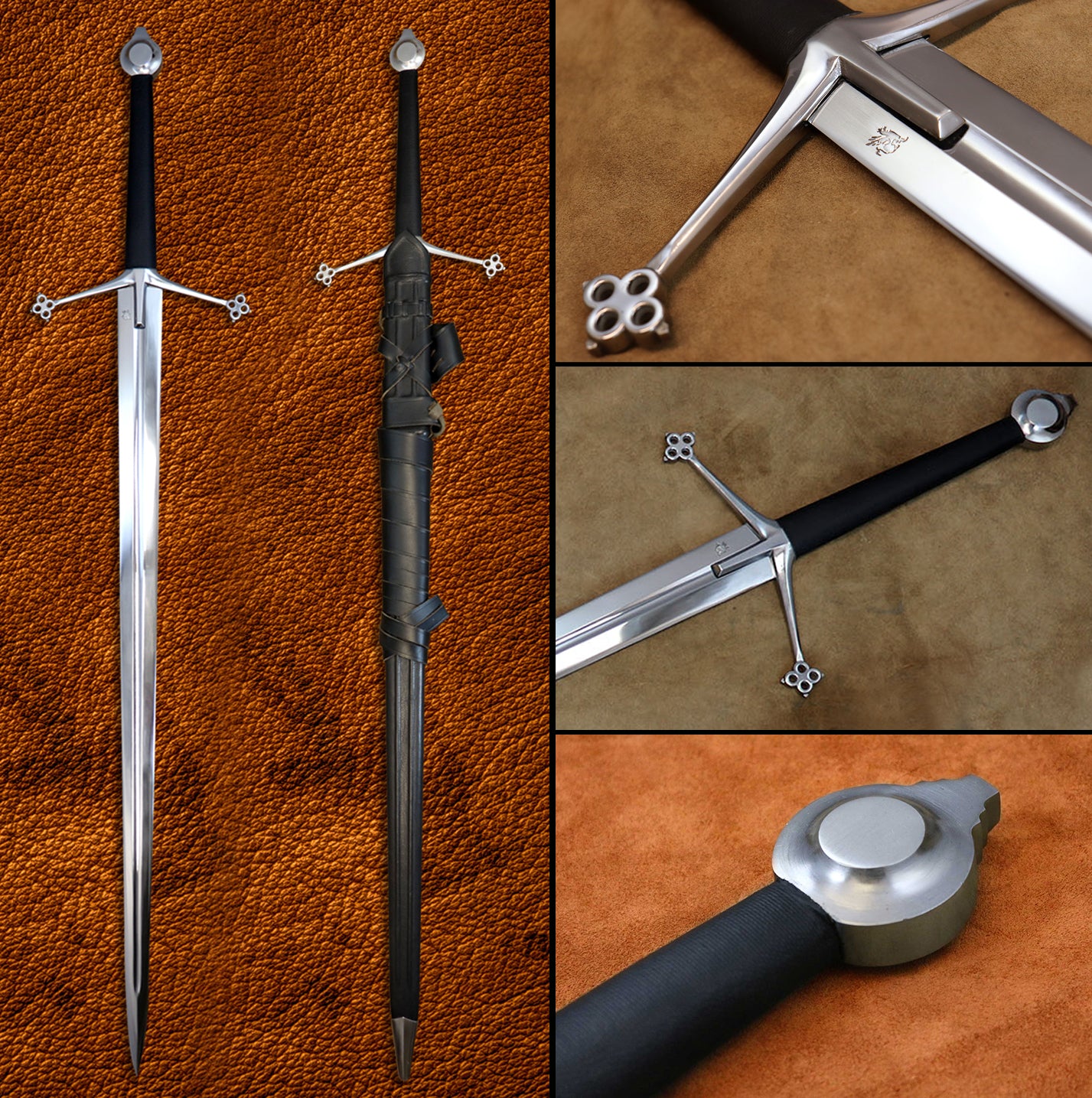
The two-handed highland Claymore, or “claidheamh mor” in Scottish Gaelic, was one of the final developments of the distinctive Scottish sword. By the 16th century, the single-handed Scottish sword with its down-turned quillons had evolved not just into a basket-hilted variety of the same blade, but also a long, two-handed sword with an unique quatrefoil guard. The Claymore was an aggressive infantry weapon. Too large to use on horseback or with a shield. It delivered overpowering blows that would sweep aside any efforts to block or parry. For over two hundred years, the Claymore witnessed inter-clan rivalries and used in wars against the English crown until the Battle of Killiecrankie in 1689.
Specifications:
Blade: 5160 High Carbon Steel.
Dual Tempered HRc 60 48-50 at the core
Total length: 48″
Blade length: 36.5″
Blade width: 2″
Weight: 4 lbs 4 oz.
Blade thickness: 1.88 mm
POB: 5″
Scottish swords, like many European swords during the Middle Ages, have their origin in the earlier Norse longswords (which were themselves and evolution of the Roman Spatha). While art and surviving examples show us that many swords used in Scotland during the Middle Ages closely resembled the swords of England and the rest of Europe, distinctive Scottish designs – especially including a guard with down-turned arms, often flared at the tips. This design became closely associated with inter-clan warfare as well as Scottish conflicts with the English.
By the 16th century, the single-handed Scottish sword with its down-turned quillons had evolved into a basket-hilted variety with the same double-edged blade. The Scottish Basket-Hilt sword would continue to be in use even into the 20th century, and could have been remembered as the distinctive Scottish sword. However, as the Basket-Hilt sword developed there was a parallel evolution occurring – one that scaled up the double-edged sword into a long, two-handed sword. Both Highland and Lowland varieties appeared on the scene in Scotland, but it would be the Highland Claymore – with it’s unique quatrefoil guard – that would most closely be associated with the Medieval weapons of the Scottish clans. While the first swords that would become known as Claymores appeared in the 1400’s, the claidheamh mor name – meaning “great sword” – was not commonly applied to this two-handed weapon until the 18th century.
Claymores were fearsome weapons, capable of taking out even armoured foes. Its broad, heavy blade was capable of severing limbs, heads, and weapons from their owners. Some sources indicate that a Scottish warrior would advance while swinging the blade in a figure eight pattern, putting any who may approach at risk of decapitation. Even mounted foes would be at risk as a Claymore was fully capable of severing legs, even heads, from fast-moving horses. The Claymore became known not only for its presence in Scottish clan conflicts but in the ongoing border strife with English forces. Its brutal effectiveness is likely why this weapon was used well into the 18th century.
Based on an early 16th century sample, the Darksword Armory Claymore is gracefully engineered as a tough high-impact, yet impressively balanced weapon. The quatrefoil quillons are carefully crafted from originals on display in the Scottish National Museum, the British Museum, The Royal Ontario Museum and The Royal Armouries (Leeds). The blade, specifically designed to deliver devastating strikes, is elegant in its simplicity. The Claymore is a weapon evocative of the Scottish highlands, and the fierce clansmen who lived, fought, and died there.
Share